What size leisure battery do I need?
It's the question that comes up more than any other, and the honest answer is that nobody can tell you a number without knowing how you want to use your van.
The good news is that working it out yourself isn't hard. It's four steps, a bit of adding up, and one piece of maths that catches almost everyone out. Half an hour with a cup of tea and you'll soon know!
Step one: work out what you actually want to use in a day
Walk through a normal day in your head, from waking up to going to sleep, and list everything that draws power. How many times a day do I boil the kettle or charge my phone? What kind of fridge do I have and how many hours is it on (e.g. 24 hours usually).
This chart gives you approximate figures for the usual suspects:
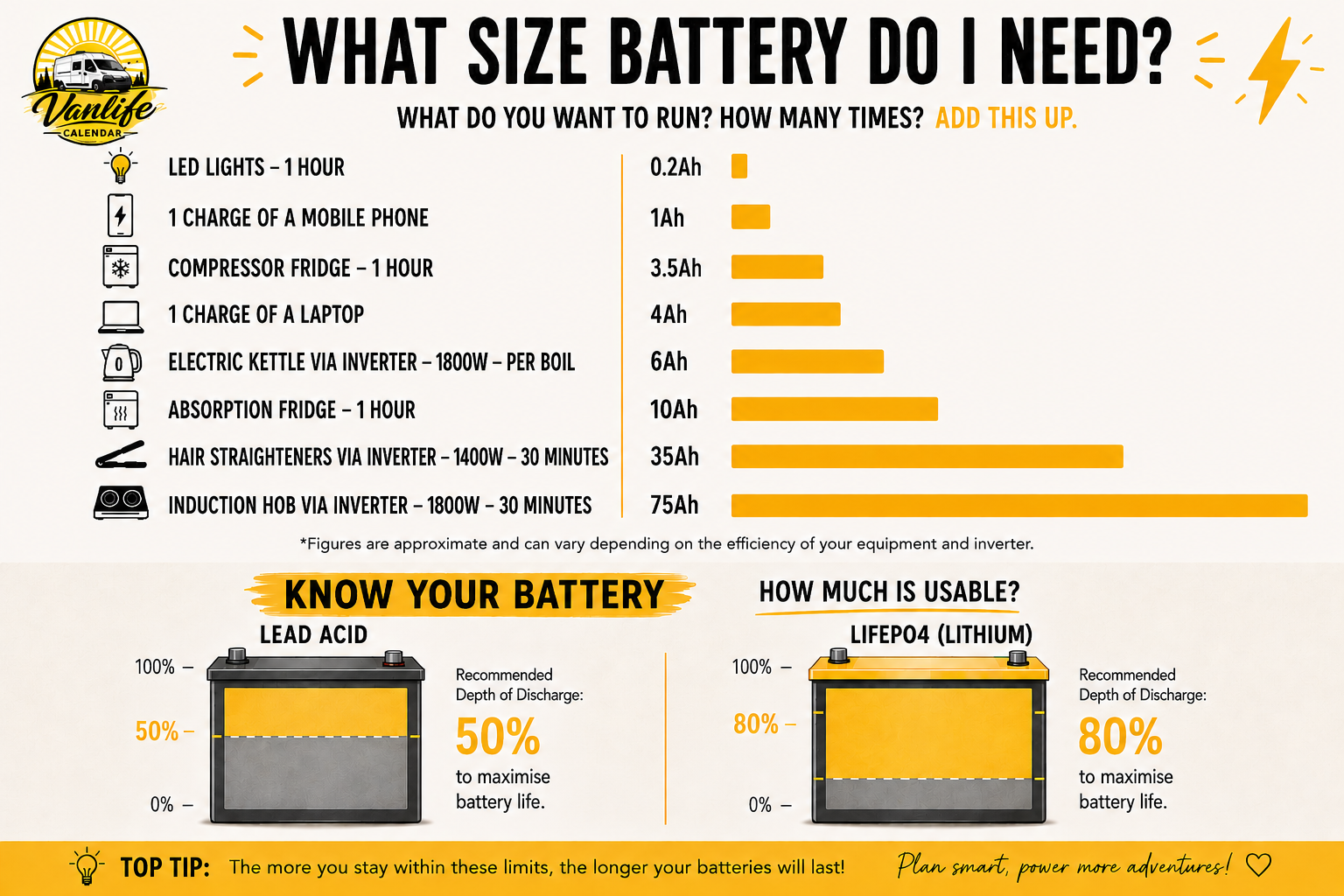
Infographic showing the different depth of discharge and how many Amp Hours are used by different appliances
A few things to notice. The fridge is almost always the biggest number, because it's the only thing running while you sleep. And anything that makes heat - the kettle, straighteners, induction hob etc is in a different league entirely. Hot things = big numbers! That's not a reason to avoid them, but it is why a van that boils water electrically needs a very different setup from one using a gas hob!
Step two: add up your day
Go through your list and total it. Something like this could be fairly typical:
Compressor fridge - 30Ah
LED lights, evening - 1Ah
Two phones - 1Ah
Laptop - 4Ah
Kettle, three brews a day - 9Ah
Daily total - 45Ah
Round it up rather than down. You'll always find something you forgot!
Step three: decide how long you want to go without charging
This is a lifestyle question, not a technical one. If you're mostly on campsites with hookup, one day is plenty. If you want to sit in a quiet spot in November with no sun and no driving, three days is more realistic.
Most people land on two or three. Multiply your daily total by that number.
At 45Ah a day, three days is 135Ah.
Step four: the bit everyone misses
Here's where the number changes shape. You cannot use all of a battery.
Yes you read that right. A 100Ah lead acid battery will get damaged if you use more than about 50% of it. Running a battery to flat seriously shortens their life. A LiFePO4 (lithium) will comfortably give you 80% but again do not run it to flat.
So a 100Ah lead acid battery is really a 50Ah battery. That's not marketing sleight of hand, it's chemistry, and ignoring it is the single most common reason people end up disappointed with a battery they've just paid for.
Divide your figure by the usable proportion:
Lead acid: Your 135Ah ideal daily usage ÷ 0.5 (the usable portion) = 270Ah. So you'd be looking at around 270-300Ah of battery
Lithium: Your 135Ah ÷ 0.8 = 168Ah. So around 170-230Ah
Same van, same habits, and the lead acid bank needs to be roughly half as big again. It'll weigh considerably more and take longer to charge.
That's the trade-off you're paying for when lithium looks expensive on paper.
And then: how are you putting it back in?
A big battery bank is only ever a bucket. It doesn't generate anything. If you've sized a 200Ah bank but you've got one small solar panel and you rarely drive, you'll spend your life running out of power.
Sanity-check your plan against how you'll actually recharge:
Solar is wonderful from April to September and much more limited in a British December.
Driving is the most reliable source if you move regularly.
Hookup reliable and a good backup for the other two.
Most people end up with two of the three. If your recharging can't replace your daily usage over the course of a week, the bank is the wrong size or you are using more power than you are generating
The mistakes worth avoiding
Sizing for your worst-ever day. You'll build a system twice as big as you need. Size for a normal day and accept that occasionally you'll be lower and have to keep an eye on it.
Forgetting the fridge runs at night. It's the quiet drain that catches people out.
Using an Absorption fridge rather than a Compressor. Yes absorption is cheaper to buy but consider this - Compressor over 24 hours = 30Ah. Absorbtion = 130 to 200Ah!! That is a massive difference
Work through those four steps and you'll have a number that's yours, based on how you actually use your van, not on what worked for someone with a different van and different habits.
Figures throughout are approximate and vary with your own kit and inverter efficiency. If you're in any doubt about wiring, fusing or installation, get it checked by someone qualified please.